A Customer Requests SOC 2 — Assessment Readiness, Timing and Quotation Inputs
“Please attach your SOC 2 report before we complete supplier approval.”
That request can arrive when a contract is almost ready to sign. Sales needs an answer, operations needs to understand the work involved, and management wants a realistic view of timing and cost.
Before promising a report date, establish what the customer expects. Which service must be covered? Is a Type 2 report specified? What reporting dates will the buyer accept? Does your organisation already have relevant assurance?
This guide helps SaaS companies, cloud service providers, managed service providers and other service organisations turn a customer request into a clear SOC 2 enquiry. For the commercial service route, see SCS SOC 2 services in UAE.
Record the Customer’s Requirement Before Booking an Assessment
Keep the original contract clause, supplier questionnaire or procurement email. A request for “SOC 2 compliance” may need clarification before anyone can determine the appropriate response.
Use a customer-requirement record like this:
|
Item to confirm |
What to record |
Why it matters |
|
Supplier identity |
The legal entity expected to provide the report |
A report belonging to another group company may not address the purchased service |
|
Purchased service |
Product, platform or managed service named by the buyer |
Coverage needs to match the service being evaluated |
|
Report requirement |
Type 1, Type 2 or wording requiring clarification |
The report type affects the examination basis and evidence needed |
|
Relevant categories |
Any specified security, availability, processing integrity, confidentiality or privacy coverage |
The enquiry should reflect the customer’s actual assurance needs |
|
Reporting dates |
Any specified date, period or recency condition |
A report’s coverage needs to be considered separately from its delivery date |
|
Submission milestone |
Tender closing, supplier approval, contract signing or service launch |
The commercial deadline may differ from the examination timetable |
|
Acceptance contact |
The buyer’s authorised procurement, security or risk reviewer |
That person can clarify ambiguous wording and acceptable interim information |
The record is a practical enquiry aid. It does not determine the examination scope or establish customer acceptance by itself.
If the account manager received the request second-hand, ask for the original wording. “Our customer needs SOC 2 next month” leaves too many important questions unanswered.
Confirm Whether the Buyer Needs a Report or Another Deliverable
Businesses often use the phrase “SOC 2 certificate.” The formal engagement produces a report. A licensed, independent CPA performs the examination under the applicable professional standards. Readiness support and the independent examination have different purposes. AICPA overview of SOC engagements
Ask whether the customer requires the report itself, a security questionnaire, evidence of preparation or several items together. A policy pack, software-platform status or readiness letter should not be described as an issued SOC 2 report.
A SOC 2 Type 2 report contains more than a statement that controls exist. AICPA’s illustrative report includes management’s assertion, a system description, the service auditor’s report, and control tests and results. AICPA illustrative SOC 2 report
Where a Type 2 report is requested, explain any different assurance you currently hold and ask the buyer what it will accept. Do not assume a Type 1 report or an ISO 27001 certificate satisfies that requirement.
For the detailed comparison, use the existing SCS SOC 2 Type 1 versus Type 2 guide.
Establish Your Current Position
There are three useful starting positions for the discussion.
A relevant SOC 2 report already exists. Identify its entity, service coverage, report type and dates. Explain any changes since the covered date or period. Arrange an appropriate review before telling the customer that the report meets its requirement.
A report exists, but its relevance is uncertain. The customer may be buying a different product, dealing with a different entity or requesting a different report type. Record the mismatch and seek clarification from the relevant parties.
No relevant report has been issued. Describe the current preparation honestly. Identify implemented controls, available records, outstanding work and any engagement already agreed. Keep planned activities separate from completed work.
This early distinction prevents an enquiry about sharing an existing report from becoming confused with an application for a first examination.
Prepare a Short Service and Responsibility Summary
Describe the service the customer actually uses. Include the responsible organisation, supporting systems, operational teams, relevant locations and significant external providers.
A cloud service provider might operate a platform using an external infrastructure provider. A managed service provider might administer customer systems while relying on another organisation for hosting. The enquiry needs to identify what each party does.
For an initial discussion, prepare:
· The service name and a plain-language description.
· The legal entity delivering it.
· The facilities, cloud environments and support locations involved.
· Important outsourced activities and provider dependencies.
· Existing service commitments relevant to the customer’s request.
· Known changes planned before or during the proposed examination.
The formal system description requires further consideration. AICPA publishes description criteria for preparing and evaluating that description. AICPA SOC 2 Description Criteria
At this stage, aim for an accurate summary that allows the proposed engagement to be understood. A list of software products alone does not explain the service or its responsibilities.
Prepare a Clear Evidence-Readiness Summary
A SOC 2 readiness assessment needs an honest account of the control environment. For the initial enquiry, summarise what is operating and what evidence can be retrieved.
|
Readiness area |
Useful initial information |
Make outstanding work visible |
|
Control ownership |
Named people responsible for relevant activities |
Unassigned or changing responsibilities |
|
Operating records |
Examples from actual access, change, monitoring or other relevant processes |
Missing dates, records or review evidence |
|
Recurring controls |
Frequency, last completion and available history |
Activities not yet performed or missed cycles |
|
External providers |
Important services and available assurance information |
Reports or responsibility details still being obtained |
|
Identified issues |
Findings, actions and current status |
Open matters affecting the proposed engagement |
Use simple status descriptions: implemented with records, implemented but not yet evidenced, planned or incomplete.
For example, an approved access-review procedure and a completed access review answer different questions. Record what has actually happened, rather than presenting the procedure as proof of recurring operation.
The existing SOC 2 audit evidence checklist provides the broader document and control-record guidance. Use it to organise detailed preparation while keeping the customer-request summary concise.
Separate the Customer Deadline From the Reporting Timetable
A customer may need a response by Friday, while the required assurance relates to a different date or period. Record those dates separately.
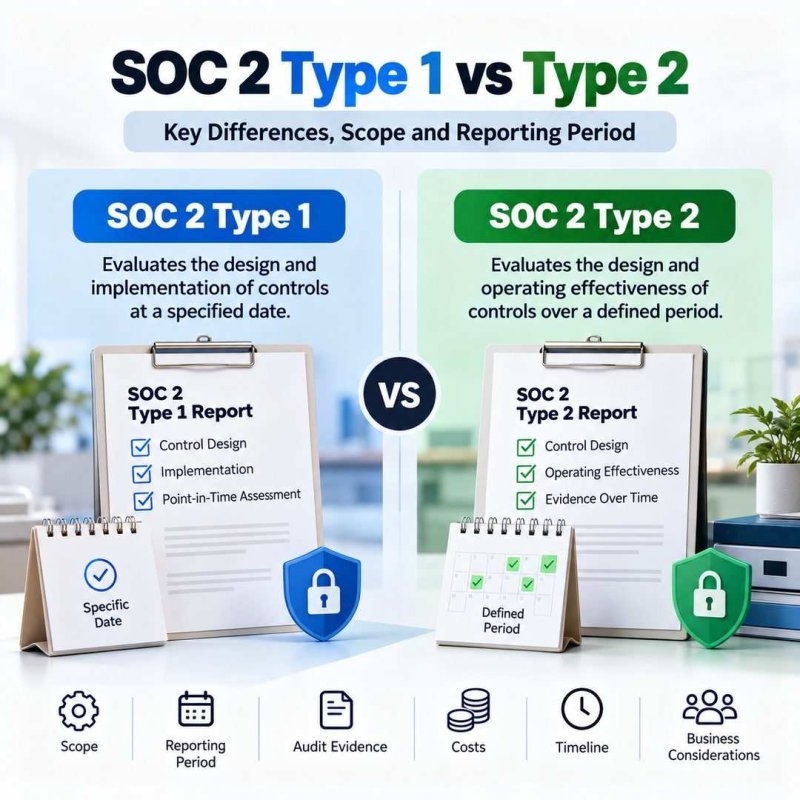
For Type 1, the examination concerns the system description and control design at a specified date. Type 2 also addresses operating effectiveness over a specified period. Those differences need to be reflected in planning. AICPA explanation of SOC report types
Discuss these milestones with the relevant providers:
1. Requirement clarification: agreement on what the customer is requesting.
2. Preparation: implementation, available evidence and outstanding actions.
3. Examination basis: the proposed date or period and scope.
4. Examination and follow-up: access to records, enquiries and evaluation of matters identified.
5. Report completion and customer submission: the actual deliverable and its controlled release.
Do not treat a scheduled meeting, completed readiness review or end of a proposed Type 2 period as a guaranteed report-delivery date.
If the customer’s deadline cannot be met with the requested report, explain the current position and ask whether it will consider interim information. The customer decides what it accepts; an application or engagement letter should not be presented as completed assurance.
Send a Quotation Brief That Describes the Requested Work
A useful SOC 2 quotation starts with a defined requirement. “Please quote for SOC 2” does not show whether the organisation needs readiness support, an independent examination or both.
Include the following in the enquiry:
· Company and contracting-entity details.
· The service and responsibility summary.
· The customer’s report requirement and acceptance conditions.
· Relevant systems, locations, personnel and outsourced activities.
· Existing reports or certificates and any known coverage gaps.
· Current evidence readiness and outstanding actions.
· The requested submission date and proposed reporting dates, if known.
· The support being requested and any services already contracted.
Clarify which party would perform each part of the work, who would issue the independent report and what the commercial proposal includes. Ask separately about any readiness support, examination, follow-up or software subscriptions relevant to the proposed arrangement.
For provider-selection questions, refer to the existing SCS SOC 2 provider-comparison article for UAE. Keep the enquiry grounded in the actual service and engagement rather than a headline price.
An Illustrative Customer-Request Decision
Consider a fictional Malaysian SaaS company with support personnel in India and externally hosted infrastructure. A UAE enterprise customer requests a SOC 2 Type 2 report before approving the service.
The supplier has an ISO 27001 certificate and a set of security policies, but no SOC 2 report. Several controls are operating, while one recurring review has not yet been completed.
The enquiry should make those facts clear. The existing certificate is background information; the outstanding review belongs in the readiness summary. The hosting provider’s assurance also needs to be considered in relation to the supplier’s own responsibilities.
The account manager asks the buyer to confirm the required service, acceptable reporting period and submission milestone. Management then submits the service summary, evidence status and customer wording for discussion of the appropriate route.
This creates a reviewable decision: what must be prepared, what examination is being proposed and what can truthfully be sent to the customer now.
The example is illustrative, not an SCS client case or a promised assessment outcome.
Connect the Enquiry to the Right Country Guide
For a SOC 2 enquiry in UAE or Saudi Arabia, identify the supplier entity and the service being evaluated. The existing UAE and Saudi Arabia SOC 2 guide provides regional background. UAE organisations can also use the main SCS SOC 2 service page for the commercial enquiry route.
For Oman, Qatar, Kuwait and Bahrain, state whether the service is delivered locally or supported through a regional operation. Refer to the existing four-country GCC SOC 2 guide for broader context.
For Malaysia, identify the service provider, relevant operating locations and any overseas support. The Malaysia SOC 2 guide covers the country-level topic.
For India, distinguish the contracting supplier from any development or support team contributing to the service. The India SOC 2 guide provides wider country guidance.
For Canada, include the customer’s requested service coverage and any relevant information-handling commitments. Use the Canada SOC 2 guide for broader country considerations.
For Singapore, the United Kingdom, the United States and other markets, submit the actual entities, service locations and requirement through SCS contact. Ask which services and engagement arrangements are available for the proposed work.
Discuss Your Customer’s SOC 2 Requirement With SCS
Start with four items: the customer’s wording, the service being purchased, your current report or readiness position, and the requested date.
These give SCS a useful basis for reviewing the enquiry and discussing the applicable scope, support and quotation route. Confirm the independent examination arrangements and the responsible reporting firm as part of that discussion.
Has a customer asked you for SOC 2? Send SCS your requirement and service details before committing to a report date or describing planned work as completed assurance.
Need ISO Certification for Your Business?
Speak with our certification specialists to understand certification requirements, audit process, implementation timelines and accredited certification services.