
Top 10 Guaranteed Best CE Marking Certification Bodies in UAE | EU Notified Body Providers | SCS
★★★★★
Need CE Marking Certification in UAE? SCS supports manufacturers, OEMs and exporters with EU CE conformity assessment and market-access requirements.
For a free CE Marking enquiry, contact SCS:
https://www.scscertification.com/contactus.php
CE marking is an important consideration for UAE manufacturers, OEMs, exporters and suppliers whose products are intended for the European market. But choosing a CE marking provider is not simply about finding a company that offers a “CE certificate.”
The applicable European Union legislation, product category and conformity assessment procedure determine what is required. In some cases, the manufacturer can complete the assessment itself. In others, EU legislation requires involvement from an appropriately designated Notified Body.
This makes the choice of a CE marking certification body or conformity assessment provider an important part of preparing for EU market access.
This article compares 10 CE marking certification bodies and providers that businesses in the UAE may consider.
Important: This article focuses specifically on the EU CE marking framework. It does not cover UAE MoIAT, ECAS, EIAC or other UAE conformity schemes.
Top 10 CE Marking Certification Bodies and Providers in UAE
| Rank | CE Marking Certification Body / Provider | Key Strength |
|---|---|---|
| 1 | TÜV SÜD | CE conformity assessment, testing and European product compliance |
| 2 | Veritas Assurance | CE marking and conformity assessment support |
| 3 | SGS | Testing, inspection and international product conformity services |
| 4 | SCS Certification | CE marking and product conformity assessment support for UAE manufacturers and exporters |
| 5 | Gabriel Registrar | Product certification and conformity assessment services |
| 6 | Bureau Veritas | Product testing, inspection and European conformity services |
| 7 | Intertek | Product testing, certification and CE conformity support |
| 8 | TÜV Rheinland | Product safety, testing and European conformity assessment |
| 9 | UL Solutions | Product safety, testing and regulatory compliance |
| 10 | DEKRA | Product safety, testing and conformity assessment services |
Note: CE requirements are product-specific. Not every CE marking project requires a Notified Body, and a company offering CE-related services should not automatically be considered a Notified Body for every EU regulation or product category. Where third-party conformity assessment is required, the applicable designation and scope should be considered.
How We Chose These CE Marking Providers
The comparison considers factors relevant to UAE manufacturers and exporters preparing products for the European market.
These include:
- Experience with CE marking and European product requirements
- Product conformity assessment capabilities
- Testing and technical evaluation experience
- Product and industry coverage
- Experience supporting manufacturers and exporters
- Conformity assessment services where applicable
- Notified Body capability for relevant EU legislation
- International product compliance experience
- Technical documentation and conformity support
- Relevance to companies operating from the UAE
The providers do not necessarily have the same Notified Body designations or technical scope. The appropriate choice depends on the product, applicable EU legislation and conformity assessment procedure.
1. TÜV SÜD
TÜV SÜD provides testing, inspection, certification and conformity assessment services across a broad range of products and industries.
For UAE manufacturers preparing products for the European market, its capabilities can be relevant to CE marking, product safety, testing, technical evaluation and regulatory conformity.
Depending on the product and applicable EU legislation, third-party conformity assessment may also form part of the process.
Manufacturers should establish the applicable European requirements before selecting the specific assessment route.
2. Veritas Assurance
Veritas Assurance provides certification and conformity assessment services for organizations seeking product and regulatory compliance.
For UAE manufacturers and exporters, CE-related support can involve reviewing product information, identifying applicable European requirements and determining the appropriate conformity assessment route.
The product's intended use and technical characteristics are important when establishing the applicable requirements.
Providing complete product information at the enquiry stage can help determine the appropriate CE pathway.
3. SGS
SGS is an international testing, inspection and certification organization with broad experience in product conformity and international market requirements.
Its capabilities can be relevant to manufacturers requiring product testing, inspection, technical evaluation or conformity assessment connected with European market access.
For UAE exporters, CE marking can form part of a wider product compliance programme involving testing, inspection, technical documentation and other assessment activities.
The actual service required depends on the product and applicable EU legislation.
4. SCS Certification
SCS Certification supports UAE manufacturers, exporters, OEMs and suppliers with CE marking and applicable product conformity assessment requirements for European market access.
The assessment begins with understanding the product, intended use, applicable EU legislation and conformity assessment procedure.
Depending on the product, CE-related work can involve technical documentation, product assessment, testing requirements and third-party conformity assessment where applicable.
SCS can support businesses looking for CE marking certification in UAE by helping establish the relevant conformity pathway rather than treating CE marking as a generic certification applicable to every product.
5. Gabriel Registrar
Gabriel Registrar provides certification and conformity assessment services for businesses seeking product and regulatory compliance.
For UAE manufacturers and exporters, CE-related work may involve assessment of applicable European requirements, product documentation and conformity procedures.
The appropriate route depends on the product and legislation governing it.
Where EU legislation requires third-party conformity assessment, the organization performing that function should have the appropriate designation for the relevant legislation and assessment procedure.
6. Bureau Veritas
Bureau Veritas provides testing, inspection and certification services across a wide range of products and industries.
Its international product conformity experience makes it relevant to manufacturers preparing products for European markets.
Depending on the product, CE-related services can involve testing, inspection, technical assessment, factory evaluation or conformity assessment.
For UAE companies exporting regulated products, the applicable European requirements should be established before selecting the conformity assessment route.
7. Intertek
Intertek provides testing, inspection and certification services for manufacturers and exporters operating across international markets.
CE marking support can form part of a wider product compliance programme involving safety testing, performance evaluation, technical documentation and regulatory assessment.
For UAE-based businesses, Intertek can be considered where a project requires product testing and European market compliance support.
The applicable conformity assessment route remains product-specific. Some products can follow manufacturer-based assessment, while others require intervention from a Notified Body.
8. TÜV Rheinland
TÜV Rheinland provides product testing, inspection, certification and regulatory compliance services internationally.
Its experience in product safety and European requirements makes it relevant to manufacturers seeking CE marking support.
Depending on the product and applicable legislation, services can include testing, technical assessment, inspection and conformity assessment.
Manufacturers should distinguish between general CE support and a formal Notified Body function.
Where EU law requires third-party conformity assessment, the organization performing that function must have the appropriate designation for the relevant legislation and assessment procedure.
9. UL Solutions
UL Solutions is internationally recognized for product safety testing, certification and regulatory compliance.
For manufacturers exporting from the UAE to European markets, its product safety and technical compliance capabilities can be relevant to CE-related projects.
CE marking can involve different technical requirements depending on the product. Electrical and electronic equipment, machinery and other regulated products can fall under different European legislative frameworks.
A provider with product testing and safety expertise can therefore be relevant where CE marking forms part of a broader product compliance programme.
10. DEKRA
DEKRA provides testing, inspection and certification services across a range of product and industrial sectors.
Its experience in product safety and conformity assessment makes it another provider that UAE manufacturers and exporters may consider when preparing products for European markets.
The appropriate CE pathway depends on the product, intended use and European legislation that applies.
Manufacturers should confirm the precise service and assessment scope required for their product before beginning the project.
What Is CE Marking?
CE marking is a conformity marking used for products covered by applicable European Union harmonisation legislation.
It indicates that the manufacturer has completed the applicable conformity assessment and is taking responsibility for the product's conformity with the relevant EU requirements.
CE marking is therefore not simply a quality mark or a universal product certificate.
Before applying the CE marking, the manufacturer needs to establish the applicable EU legislation, relevant requirements, conformity assessment procedure and documentation.
Whether a Notified Body is required also depends on the product and the applicable legislation.
Is CE Certification Required for Every Product?
No.
Not every product requires the same CE conformity assessment procedure, and not every product requires a Notified Body.
For some products, the manufacturer can carry out the applicable conformity assessment itself. For others, European legislation requires an independent third party to perform specific conformity assessment activities.
This is important for companies searching for CE certification in UAE because there is no single CE route that applies to every product.
CE Marking and Notified Bodies
A Notified Body is an organization designated under the applicable EU framework to perform specific conformity assessment tasks.
Notified Body status is not a general authorization covering every product.
An organization may have extensive CE marking experience while not being a Notified Body for a particular European regulation. It may also be notified only for specific legislation, product categories or conformity assessment procedures.
For this reason, the relevant question is whether the organization has the appropriate capability or designation for the conformity assessment required by the product.
Why NANDO Matters for CE Marking
NANDO stands for New Approach Notified and Designated Organisations.
The European Commission's NANDO database is the official EU reference for notified bodies.
It provides information about organizations notified for particular European legislation and conformity assessment activities.
For manufacturers whose products require third-party conformity assessment, NANDO is an important reference when considering the appropriate Notified Body.
NANDO is not a ranking of CE certification companies. Its relevance is that it helps establish whether an organization has been notified for the particular European legislation and conformity assessment activity relevant to a product.
CE Marking for UAE Manufacturers and Exporters
UAE manufacturers may require CE marking when their products are intended to be placed on the European market and fall within applicable EU product legislation.
Depending on the product, this can include:
- Machinery
- Electrical and electronic equipment
- Construction products
- Medical devices
- Pressure equipment
- Lifts and safety components
- Industrial equipment
- Consumer products
- OEM products
- Components and assemblies
The requirements differ between these categories, so the product and intended use should be established before selecting the conformity assessment route.
For UAE exporters, CE marking can be part of preparing products for European distributors, customers and market access.
CE Marking Process in Brief
Although the exact process varies by product, a CE marking project generally starts with identifying the product and its intended use.
The manufacturer then determines the applicable EU legislation, relevant technical requirements and conformity assessment procedure.
Depending on the product, the process may involve:
- Product and legislation assessment
- Identification of applicable standards and requirements
- Testing or technical evaluation where required
- Preparation of technical documentation
- Notified Body assessment where required
- EU Declaration of Conformity where applicable
- Application of the CE marking
The specific route should be established for the individual product rather than copied from another product category.
CE Marking for Electrical and Electronic Products
Electrical and electronic products can fall under several European requirements depending on their design, function and intended use.
Potential considerations can include electrical safety, electromagnetic compatibility, restrictions on certain substances and radio equipment requirements where applicable.
This is why one generic CE certificate should not be assumed to cover every electrical or electronic product.
For detailed information on this product category, see the dedicated SCS article on CE Marking Certification for Electrical & Electronic Products in UAE.
CE Marking for Machinery
Machinery placed on the European market can be subject to specific European safety requirements.
Depending on the product and applicable framework, assessment can involve machinery design, risk assessment, technical documentation, instructions, testing and conformity assessment.
Where the applicable legislation requires third-party assessment, an appropriately designated Notified Body may need to participate.
For detailed machinery requirements, manufacturers should refer to the dedicated SCS machinery CE marking resource.
CE Marking for Construction Products
Construction products can have specific European requirements connected with their technical specifications and applicable conformity assessment system.
The CE marking route can involve product performance, factory production controls, testing, assessment and technical documentation.
The applicable European framework should therefore be established before selecting a CE marking provider.
CE Marking for Medical Devices
Medical devices follow a specific European regulatory framework.
The conformity assessment route depends on factors including the device classification and applicable requirements.
Certain medical devices require Notified Body involvement, while the exact assessment process depends on the product category.
UAE medical device manufacturers and exporters should work with providers that understand the relevant European medical-device requirements.
CE Marking for Pressure Equipment
Pressure equipment can fall under the European Pressure Equipment Directive when the relevant scope and conditions are met.
The conformity assessment route depends on factors such as equipment classification and the applicable assessment procedure.
Pressure vessels, piping, pressure accessories and assemblies can therefore have different assessment requirements.
CE Marking for Lifts and Safety Components
Lifts and certain lift safety components are subject to specific European requirements.
The conformity assessment process can involve different procedures depending on the product and applicable assessment route.
For UAE manufacturers, installers and exporters, the applicable European legislation should be identified before determining whether third-party assessment is necessary.
Sample CE Marking Certificate
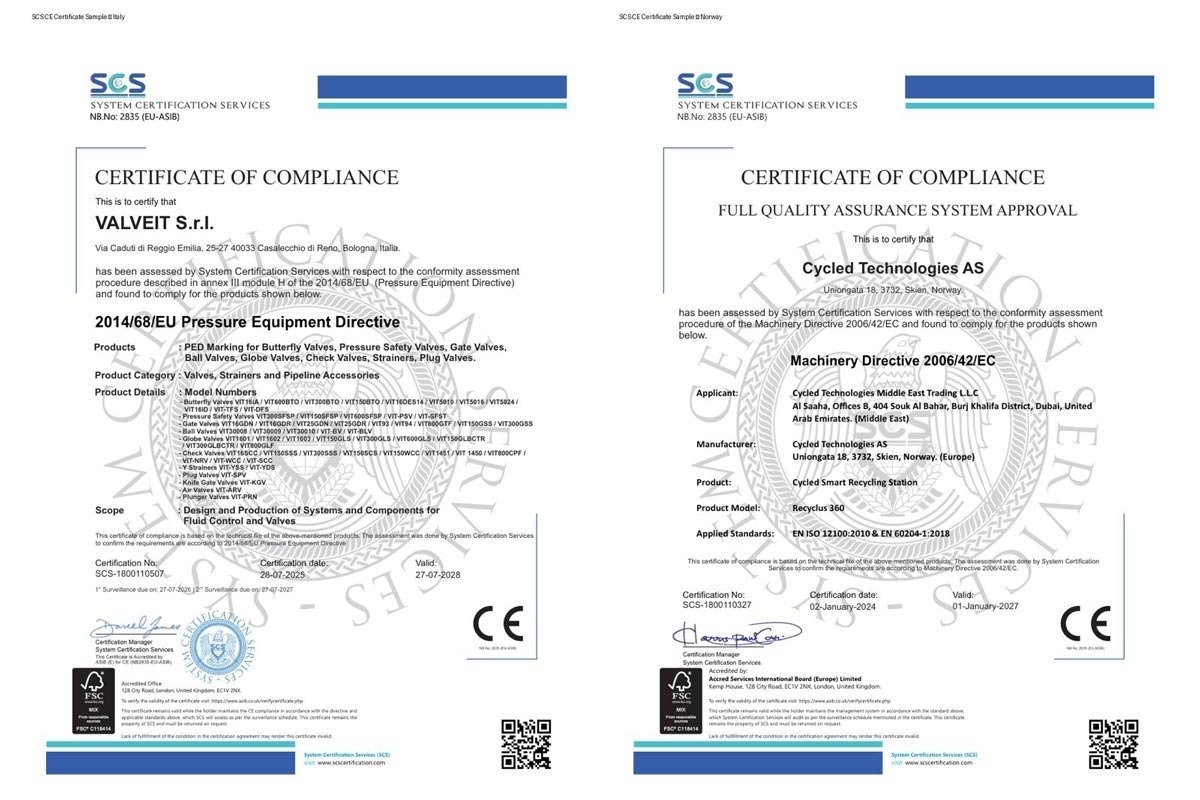
Sample CE marking certificate for reference. Actual CE-related documentation depends on the product, applicable EU legislation and the required conformity assessment procedure.
There is no single universal CE certificate format issued for every product under EU law.
Depending on the product and conformity assessment route, CE-related documentation may include an EU Declaration of Conformity, technical documentation, test reports, assessment reports or documentation issued by a Notified Body where third-party conformity assessment is required.
A sample document should therefore be treated as an illustration rather than a universal CE certificate template.
CE Marking Cost in UAE
There is no single fixed price for CE marking certification in UAE.
Cost can depend on:
- Product type
- Product complexity
- Applicable EU legislation
- Number of product models
- Testing requirements
- Existing test reports
- Technical documentation
- Factory assessment requirements
- Notified Body involvement
- Conformity assessment procedure
- Manufacturing locations
A straightforward product can require a very different budget from a technically complex product requiring extensive testing and third-party assessment.
A useful CE marking quotation therefore normally requires product information before the price can be determined.
CE Marking Documentation
Depending on the product and applicable legislation, CE-related documentation can include:
- Product specifications
- Technical drawings
- Risk assessment
- Test reports
- Design information
- Applicable standards
- Technical documentation
- User instructions
- Product identification and labelling
- Factory or production information
- Assessment reports or certificates where applicable
- EU Declaration of Conformity
The precise documentation depends on the European legislation applicable to the product.
CE Marking Certificate vs EU Declaration of Conformity
These terms are often used interchangeably online, but they are not necessarily the same document.
The EU Declaration of Conformity is the manufacturer's formal declaration that the product complies with the applicable EU legislation.
A generic “CE certificate” is not a universal EU document issued for every product.
Where third-party conformity assessment is required, a Notified Body may issue documentation associated with the conformity assessment procedure it performs.
This distinction is important when comparing CE certification companies in UAE.
A provider should explain what assessment and documentation are actually required for the product rather than simply promising a generic CE certificate.
CE Marking Providers in Dubai, Abu Dhabi and Across UAE
Manufacturers based in Dubai, Abu Dhabi or another UAE emirate can seek CE marking and conformity assessment support for products intended for the European market.
The relevant considerations are the product, applicable EU legislation, technical requirements and conformity assessment route rather than simply the location of the manufacturer.
UAE businesses can therefore select a provider based on relevant product expertise and the services required for their European market-access plans.
How to Choose a CE Marking Certification Body in UAE
Choosing a CE marking provider should start with the product rather than the provider's marketing description.
Consider these questions:
Does the provider understand my product category?
Experience with machinery, for example, may differ from experience with medical devices, construction products or electrical equipment.
Which EU legislation applies to my product?
This should be established before the conformity assessment route is selected.
Is a Notified Body actually required?
Not every CE marking project requires one.
If a Notified Body is required, does the organization have the relevant designation?
The designation should correspond to the applicable legislation and conformity assessment procedure.
What testing is required?
Testing requirements can vary substantially between products.
What documentation will be required?
The provider should explain the technical documentation and conformity evidence relevant to the product.
Can existing test reports be used?
Existing reports may be useful in some cases, but their suitability depends on the applicable European requirements.
What does the quotation include?
Clarify whether the quotation covers testing, technical review, factory assessment, third-party assessment, documentation review or other activities.
CE Marking Provider vs Notified Body
These terms should not be treated as interchangeable.
A CE marking provider may support manufacturers with product compliance, technical documentation, testing coordination, conformity assessment and related regulatory activities.
A Notified Body is specifically designated to carry out certain conformity assessment tasks under applicable EU legislation.
Some organizations can provide broader CE-related services and also hold Notified Body designations for particular European legislation.
The relevant question is therefore not simply whether a company calls itself a CE certification body.
The more useful question is whether the organization can provide the conformity assessment required for the specific product under the applicable EU legislation.
Why Product Classification Matters
Two products that appear similar may follow different CE routes.
Differences in intended use, design, operating conditions, risk, technical characteristics and market application can affect the applicable legislation and conformity assessment procedure.
This is why a CE marking assessment should begin with accurate product information.
For UAE exporters, providing technical details at the quotation stage can make it easier to establish the appropriate conformity pathway.
CE Marking for OEMs and Private-Label Products
OEM and private-label arrangements can raise additional questions about manufacturer responsibilities and technical documentation.
The company carrying the relevant manufacturer responsibilities under the applicable European framework needs to understand its obligations before applying the CE marking.
The relationship between the manufacturer, importer, distributor and brand owner can also be relevant.
A CE marking provider can help establish which conformity and documentation responsibilities apply to the particular arrangement.
CE Marking for Multiple Products
Companies with several product models should not automatically assume that one assessment covers every product.
Some models may share enough technical characteristics to be considered together, while others may require separate assessment.
Whether products can be assessed together depends on their characteristics and the applicable European requirements.
CE Marking for Multiple Manufacturing Locations
Companies operating more than one manufacturing location should disclose this during the initial assessment.
The manufacturing location can become relevant where the conformity assessment procedure includes production controls, factory assessment or site-specific activities.
The final assessment arrangement depends on the applicable product legislation and conformity assessment procedure.
Why UAE Manufacturers Work with CE Marking Providers
A UAE company may seek CE marking support to:
- Export products to the European market
- Meet European customer requirements
- Supply products to EU distributors
- Prepare products for international tenders
- Demonstrate conformity with applicable EU product requirements
- Organize product testing
- Prepare technical documentation
- Determine whether a Notified Body is required
- Support European market entry
CE marking should be approached as part of product regulatory compliance rather than simply as a standalone certificate.
SCS Certification for CE Marking in UAE
SCS Certification supports UAE manufacturers, exporters, OEMs and suppliers with CE marking and applicable product conformity assessment requirements.
The process begins with understanding the product, intended use, applicable European requirements and conformity assessment route.
Depending on the product, SCS can support manufacturers with CE-related assessment requirements, technical documentation, product compliance and coordination of applicable conformity assessment activities.
For companies searching for CE marking certification in UAE, SCS provides a practical starting point for discussing the requirements before proceeding with the appropriate assessment route.
Request a CE Marking Quotation from SCS
If your company is preparing a product for the European market, the first step is to provide sufficient product information to establish the applicable CE requirements.
Useful information can include:
- Product name and description
- Intended use
- Product specifications
- Technical drawings
- Applicable standards, if already identified
- Manufacturing location
- Existing test reports
- Target EU market
- Number of product models
- Existing certification or conformity documentation
SCS can review the available information and help determine the appropriate CE marking and conformity assessment pathway.
For a free CE Marking enquiry, contact SCS:
https://www.scscertification.com/contactus.php
Final Thoughts
CE marking is not a one-size-fits-all certification process.
For UAE manufacturers and exporters, the starting point is identifying the European legislation applicable to the product, understanding the required conformity assessment procedure and selecting a provider with relevant product and regulatory experience.
NANDO is an important official EU reference when a Notified Body is required, but CE marking should not be reduced to simply obtaining a certificate.
The appropriate route depends on the product.
For businesses in the UAE preparing products for European markets, choosing a CE marking provider with the right product expertise and understanding of the applicable EU conformity assessment route can make the process more straightforward.
Disclaimer: This article provides general information about CE marking and EU product conformity requirements. CE obligations vary according to the product, intended use, applicable EU legislation and conformity assessment procedure. Not every CE marking project requires a Notified Body. Provider capabilities and designations can also vary by legislation and product category. Manufacturers should confirm the requirements applicable to their specific product before placing it on the European market.
Need CE Mark Certification for Your Products?
Speak with our certification specialists to understand certification requirements, audit process, implementation timelines and accredited certification services.