SOC 2 Audit Evidence Checklist: Documents, Controls and Requirements for Businesses
Preparing for a SOC 2 examination involves more than creating security policies or collecting screenshots. Organizations need to demonstrate how their controls are designed, implemented and operated within the defined system scope.
For SaaS companies, cloud service providers, fintech businesses, managed service providers and technology organizations, a structured SOC 2 audit evidence checklist can make preparation easier to manage.
Evidence may come from policies, access management platforms, cloud infrastructure, ticketing systems, security monitoring tools, employee records, vendor assessments and operational procedures.
This guide explains what SOC 2 audit evidence may include, how to organize documentation, what Type I and Type II examinations involve, and how businesses can prepare evidence without creating unnecessary paperwork.
Terminology note: SOC 2 is technically an examination and reporting framework, not an ISO-style certification scheme. The phrase “SOC 2 certification” is commonly used in commercial searches, but the engagement results in a SOC 2 report issued by an appropriately qualified independent CPA practitioner.
What Is SOC 2 Audit Evidence?
SOC 2 audit evidence is information examined by the service auditor to evaluate whether the controls relevant to the organization's system and selected Trust Services Criteria are suitably designed and, where applicable, operating effectively.
Evidence helps establish what the organization actually does, rather than what its policies say it should do.
For example, a company may have a written access-control policy requiring periodic user access reviews. Supporting evidence could include:
-
The user access listing for the review period
-
The reviewer's approval or sign-off
-
Records of access changes
-
Evidence that inappropriate access was removed
-
The date and scope of the review
A policy alone may not demonstrate that the review took place.
The exact evidence required depends on the organization's services, system boundaries, risks, selected criteria, control design and examination procedures.
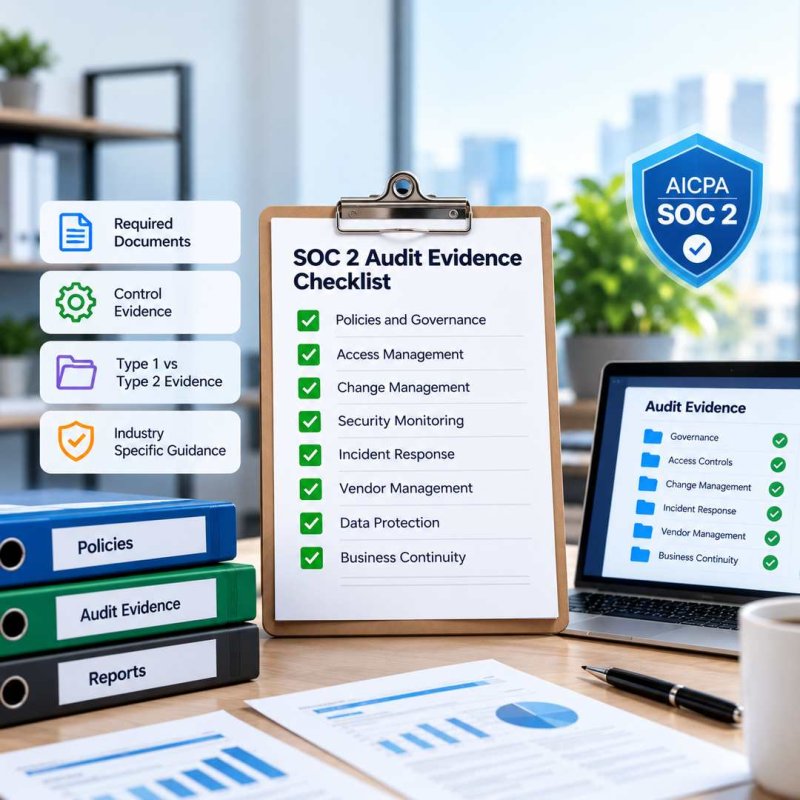
SOC 2 Audit Evidence Checklist
The following checklist is a practical preparation guide. It is not a universal list of mandatory documents; organizations should tailor it to their actual scope and control environment.
1. Governance and Security Documentation
| Evidence area | Illustrative records |
|---|---|
| Information security policy | Approved policy, review history and communication records |
| Organizational responsibilities | Security roles, responsibilities and assigned control owners |
| Risk assessment | Risk register, assessment methodology and review records |
| Security objectives | Defined objectives, responsibilities and monitoring records |
| Policy management | Approval history, version control and review evidence |
| Exception management | Approved exceptions, rationale, ownership and expiry or review dates |
| Security awareness | Training material, attendance and completion records |
2. User Access and Identity Management
Access management is an important evidence area for many technology organizations.
Potential records include:
-
User account listings
-
New user access requests and approvals
-
Role and permission assignments
-
Privileged account listings
-
Multi-factor authentication configurations
-
Periodic access review records
-
Employee termination notifications
-
Account deactivation records
-
Service account inventories
-
Records of access exceptions
For a Type II examination, evidence should demonstrate how the applicable controls operated during the defined examination period.
3. Change Management and Software Development
For SaaS companies and software providers, change management evidence may include:
-
Change management policy or procedure
-
Change tickets
-
Approval records
-
Code review records
-
Testing results
-
Deployment logs
-
Emergency change records
-
Segregation of development and production access
-
Release management records
-
Evidence of post-implementation review, where applicable
A useful evidence trail connects a change request with its approval, testing, implementation and relevant follow-up.
4. Security Monitoring and Vulnerability Management
Depending on the system and controls, evidence may include:
-
Security monitoring alerts
-
Log review records
-
Vulnerability scan results
-
Remediation tickets
-
Security incident records
-
Endpoint protection status
-
Security configuration reviews
-
Penetration test reports, where applicable
-
Follow-up actions for identified weaknesses
-
Monitoring escalation records
The presence of a security tool does not by itself demonstrate that monitoring or remediation controls operate effectively. Records should show the relevant activity and follow-up.
5. Incident Response and Business Continuity
Organizations may prepare:
-
Incident response policy
-
Incident register
-
Investigation records
-
Incident severity classification
-
Escalation and communication records
-
Corrective action tracking
-
Business continuity arrangements
-
Disaster recovery procedures
-
Backup monitoring records
-
Recovery test results
-
Lessons-learned records
Where an organization has not experienced an actual incident, it should not fabricate incident records. Relevant procedures, exercises, tests and other applicable evidence may demonstrate preparedness.
6. Vendor and Third-Party Management
Cloud hosting providers, software vendors and outsourced service providers may form part of the organization's service delivery environment.
Potential evidence includes:
-
Vendor inventory
-
Vendor risk assessments
-
Due diligence records
-
Contractual security requirements
-
Relevant supplier assurance reports
-
Periodic vendor reviews
-
Issue follow-up records
-
Approval of new critical suppliers
-
Subservice organization considerations
The organization should understand which third parties are relevant to its system and how responsibilities are addressed.
7. Data Protection and Confidentiality
Depending on the selected criteria and system scope, evidence may include:
-
Data classification records
-
Data handling procedures
-
Encryption configurations
-
Key management arrangements
-
Data retention and disposal records
-
Confidentiality commitments
-
Privacy notices and procedures, where applicable
-
Data access restrictions
-
Relevant customer commitments
Privacy-related evidence should be aligned with the organization's actual processing activities and applicable obligations.
SOC 2 Type I vs Type II: Evidence Differences
The evidence preparation approach depends partly on the report type.
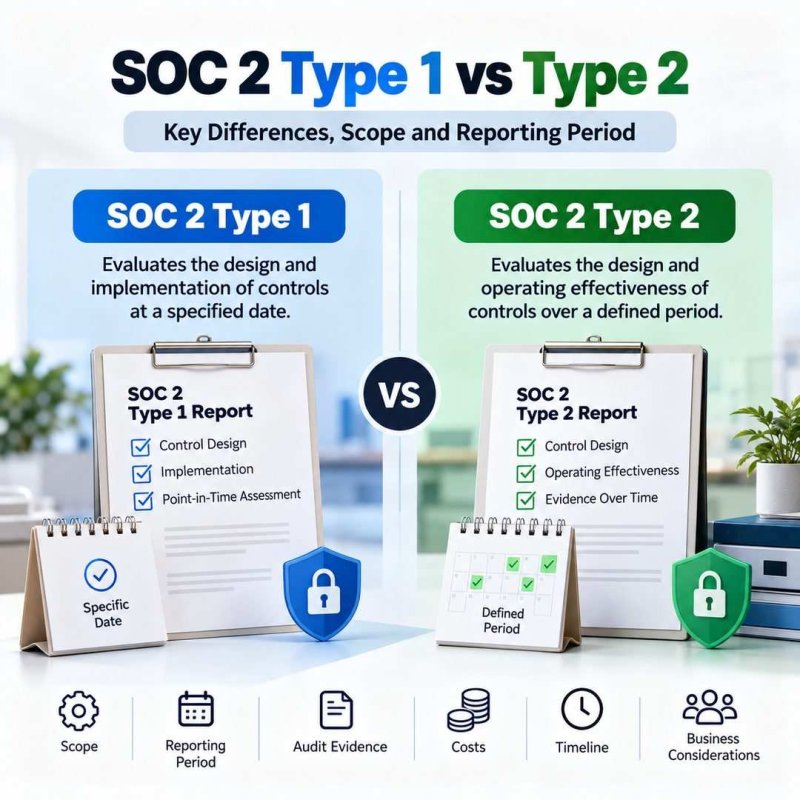
| Area | SOC 2 Type I | SOC 2 Type II |
|---|---|---|
| Assessment focus | Control design at a specified date | Control design and operating effectiveness over a defined period |
| Evidence emphasis | Relevant documentation and implementation status at the assessment date | Records demonstrating control operation throughout the period |
| Access controls | Configuration and relevant approvals at the specified date | Access requests, reviews and changes sampled across the period |
| Change management | Control design and implementation | Change records, approvals, testing and deployment evidence over time |
| Monitoring | Relevant arrangements at the specified date | Monitoring and follow-up records during the period |
| Reporting period | Point-in-time assessment | Defined examination period |
A Type II examination period is commonly six or twelve months, although the appropriate period depends on the engagement and customer requirements. There is no universal rule that every organization must use one fixed period.
For a fuller explanation, read the SCS article on SOC 2 Type 1 vs Type 2.
How to Organize SOC 2 Audit Evidence
A consistent evidence structure helps control owners respond to requests without repeatedly searching through emails, shared drives and disconnected systems.
One practical arrangement is:
SOC 2 Evidence Repository
-
01 — System Scope and Description
-
02 — Governance and Security Policies
-
03 — Risk Assessment and Treatment
-
04 — User Access Management
-
05 — Change Management
-
06 — Security Monitoring
-
07 — Incident Response
-
08 — Vulnerability Management
-
09 — Vendor and Third-Party Management
-
10 — Backup and Recovery
-
11 — Employee Security and Training
-
12 — Data Protection and Confidentiality
-
13 — Control Testing and Exceptions
-
14 — Remediation and Follow-up
Organizations may use a controlled document repository, governance platform, evidence automation tool or other suitable system.
Recommended SOC 2 Evidence Register
| Field | Purpose |
|---|---|
| Evidence ID | Unique reference |
| Control reference | Related control or requirement |
| Evidence description | What the record demonstrates |
| Control owner | Responsible person or team |
| Evidence period | Relevant date or timeframe |
| Collection frequency | Monthly, quarterly, event-based or other defined interval |
| Status | Available, under review, pending or action required |
| Repository location | Controlled storage location |
| Reviewer | Person responsible for checking completeness |
| Follow-up | Outstanding action, if any |
Evidence should be protected against unauthorized alteration or disclosure. Access to the repository should reflect the sensitivity of the records.
What Makes SOC 2 Evidence Reliable?
Good evidence should be relevant, complete enough for its purpose, traceable and consistent with the control being examined.
Before submitting a record, consider:
-
Does it relate to the correct system and control?
-
Is the date or reporting period clear?
-
Can the source be identified?
-
Does it show the actual activity or only describe a policy?
-
Are approvals and exceptions visible where relevant?
-
Is the record complete and readable?
-
Does it contain sensitive information that should be appropriately protected?
-
Can the control owner explain how it was produced?
Screenshots can sometimes support evidence, but system-generated records, audit logs, tickets and controlled reports may provide more useful detail depending on the control.
Do not alter evidence in a way that misrepresents the underlying activity. If redaction is necessary to protect confidential information, preserve the integrity of the underlying record and follow the agreed evidence-handling process.
Common SOC 2 Evidence Preparation Gaps
| Common gap | Practical response |
|---|---|
| Policies exist but operating records are missing | Identify recurring controls and retain evidence as activities occur |
| Access reviews are incomplete | Assign a reviewer, define the review scope and track resulting actions |
| Change tickets lack approvals or testing records | Improve the change workflow and required fields |
| Vendor reviews are outdated | Establish risk-based review responsibilities and dates |
| Evidence is scattered across teams | Use a central register and controlled repository |
| Screenshots lack dates or context | Record the source, date, system and relevant control |
| Findings remain open without ownership | Assign an owner, due date and documented follow-up |
| Type II evidence collection starts too late | Establish evidence routines before or at the start of the examination period |
| The system scope is unclear | Document services, infrastructure, boundaries and relevant dependencies |
The objective is not to generate paperwork for its own sake. Evidence should reflect genuine business activities and help the organization manage its security responsibilities.
SOC 2 Evidence Preparation by Industry
SaaS and Software Companies
Typical preparation areas include identity and access management, software changes, production deployments, vulnerability management, incident response and cloud infrastructure.
Fintech and Financial Technology Providers
Evidence may also relate to transaction processing, sensitive information, access restrictions, service availability and relevant customer commitments. Separate financial-sector regulatory obligations should be assessed independently.
Cloud and Managed Service Providers
Organizations may need to consider infrastructure monitoring, privileged access, customer segregation, service availability, backup arrangements and third-party dependencies.
IT Outsourcing and Technology Service Companies
Relevant evidence may include employee onboarding and offboarding, customer access authorization, service tickets, incident handling, supplier controls and security training.
The applicable evidence depends on the services actually included in the SOC 2 system.
How SCS Can Support SOC 2 Readiness
Organizations preparing for SOC 2 can benefit from a structured review of their intended scope, controls, documentation and evidence collection arrangements.
SCS can be approached for information on SOC 2 readiness and related compliance support. Organizations should confirm the specific scope of any support engagement and distinguish readiness or consulting activities from the independent CPA examination and report.
For country-specific information, see:
-
SOC 2 Certification in UAE, Dubai, Abu Dhabi and Saudi Arabia
-
SOC 2 Certification in Oman, Qatar, Kuwait and Bahrain, with UAE and Saudi coverage
Businesses comparing providers in the UAE can also refer to the SOC 2 firms and compliance providers comparison.
Final SOC 2 Audit Evidence Readiness Check
Before the formal examination, confirm that:
-
The system scope is documented and understood.
-
Applicable Trust Services Criteria have been identified.
-
Control owners and responsibilities are assigned.
-
Relevant policies and procedures are approved and maintained.
-
Access and change-management records are available.
-
Security monitoring and incident processes are operating.
-
Vendor and third-party responsibilities are understood.
-
Evidence is traceable to relevant controls and dates.
-
Exceptions and remediation actions are tracked.
-
Evidence is stored securely and can be retrieved by authorized personnel.
-
The evidence collection approach matches the intended Type I or Type II engagement.
A well-managed evidence process helps an organization explain how its controls work and reduces avoidable last-minute preparation.
References
-
AICPA — SOC for Service Organizations: https://www.aicpa-cima.com/
-
AICPA Trust Services Criteria: https://www.aicpa-cima.com/
-
SCS Certification SOC 2 country guides and related resources listed above.
Need ISO Certification for Your Business?
Speak with our certification specialists to understand certification requirements, audit process, implementation timelines and accredited certification services.